On this page
- Quick Summary
- What Samaria Gorge Is
- What Makes It Special
- History and Identity
- Things to Do
- Hiking the Gorge In Detail
- Difficulty and Timing
- Can You Go Without a Guide
- Can You Swim in the Gorge
- Route, Access, and Return
- Weather and Best Time to Visit
- Food, Stops, and Nearby Places
- Practical Tips
- Nearby Attractions
Quick Summary
Samaria Gorge is part of the National Park of Samaria in the White Mountains of western Crete.
The standard route is a one-way descent with a distance commonly given as 16 km, ending at the coastal village of Agia Roumeli.
The trail is open seasonally, traditionally from 1 May to 31 October, with opening and closing times that can shift for weather or safety reasons.
It is a real hike that requires a reasonable level of fitness. It is not a casual day out.
No guide is needed for the standard route, but transport planning is essential because the walk ends away from where it starts.
The exit from Agia Roumeli is by ferry, with connections to Hora Sfakion and other south-coast ports.
May, June, and September offer the best conditions for most hikers: manageable temperatures and a trail that is fully open.
What Samaria Gorge Is
Samaria Gorge is a major hiking route and protected natural area in western Crete. The gorge sits within the White Mountains and forms part of a national park that covers a large range of plant and animal species. That combination of geology, ecology, and scale is what gives the hike its reputation.
The route is known for its dramatic cliffs, a long controlled descent, and a finish at the coastal village of Agia Roumeli on the Libyan Sea. It is one of those hikes where the endpoint feels like a genuine reward, because you arrive at the coast after crossing the interior of the gorge on foot. The trail does not loop back. It begins high in the mountains and ends by the sea, which gives it a clear structure and a strong sense of direction from the first step to the last.
That linear character is important to understand before you plan the day. Samaria is not a walk you can start and turn around from whenever you feel like it. Once you commit to the route, you commit to the logistics that come with it.
What Makes It Special
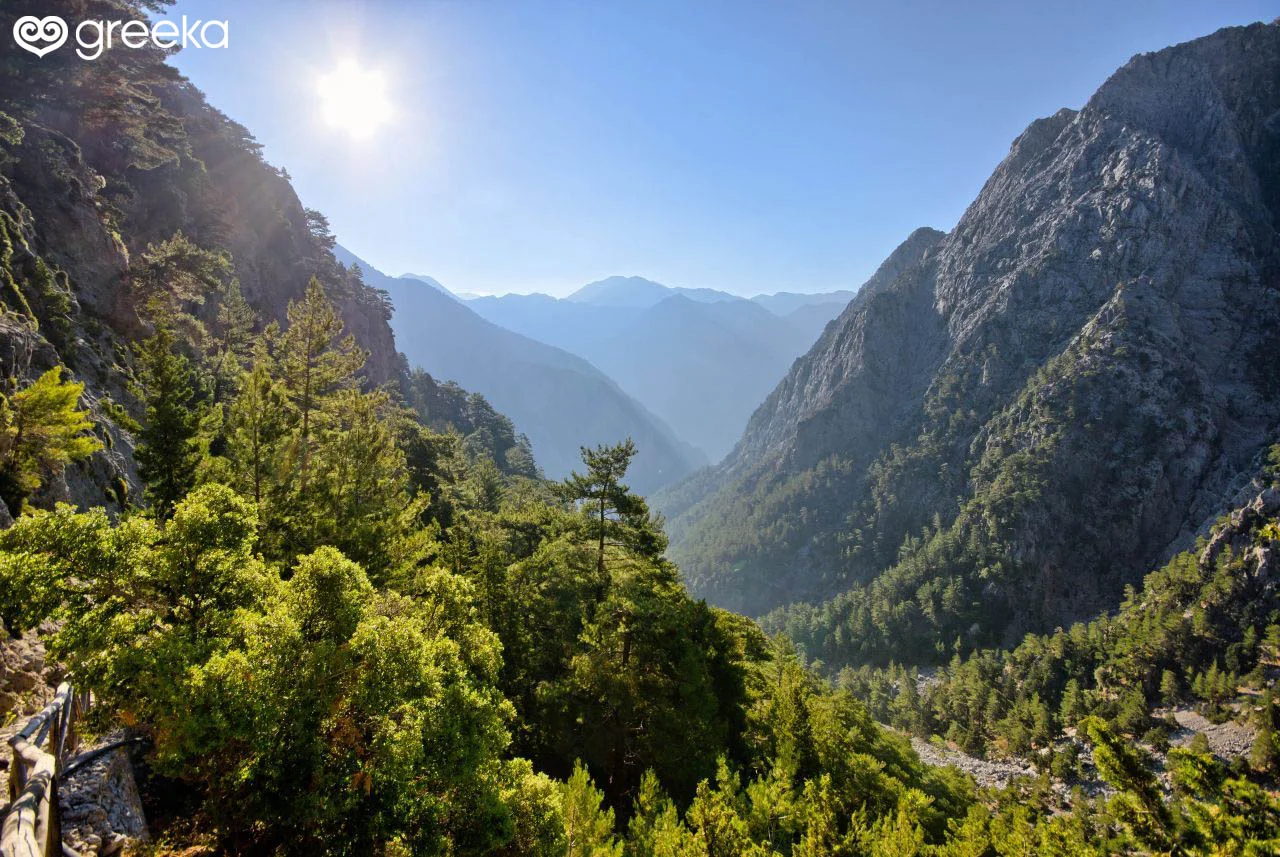
The standout quality of Samaria Gorge is its scale. The trail descends from around 1,200 metres altitude down to sea level over the course of the walk, and the gorge walls in the narrowest sections rise steeply on both sides. That combination of elevation change and geology gives the hike a visual impact that is difficult to reproduce anywhere else in Greece.
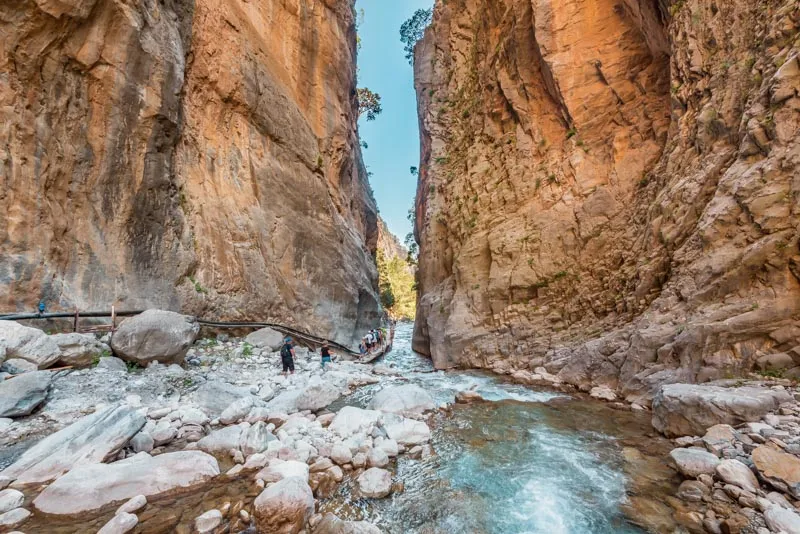
The character of the trail shifts as you move through it. The early sections are about entry and descent, with a wide path and mountain views. As you go deeper, the gorge narrows and the cliffs become more dramatic. The narrowest point, known as the Iron Gates, is where the walls close to just a few metres apart and the light changes completely. After that, the route gradually opens out and the village of Agia Roumeli and the sea begin to come into view. That progression is a large part of why the hike stays memorable for most people who do it, even those who have walked in mountain terrain elsewhere.
It also matters that Samaria is a managed environment. It is a national park with official opening hours, entrance fees, and seasonal access rules. The walk is supervised and regulated, not informal. That benefits the experience, because the trail is maintained and rescue services are available, but it also means you need to treat it like a regulated mountain hike rather than an improvised day out.
History and Identity
Samaria Gorge has a long identity as a protected Cretan landscape. The national park status is central to how the place is understood, both by the authorities who manage it and by the travelers who search for it. The gorge has been a route through the White Mountains for centuries, and the abandoned village of Samaria sits partway along the trail, giving the walk a historical dimension that goes beyond scenery.
The village was inhabited until 1962, when residents were relocated to allow the national park to be established. The old church of Osia Maria, from which the gorge takes its name, still stands in the ghost village and is one of the points of interest along the route. Walking through it gives a sense of how people once lived in this landscape, enclosed by mountains and dependent on the gorge path as the main connection to the outside.
The trail's link to Agia Roumeli at the south coast is equally part of its identity. That coastal village is the end of the hike, the place where the ferry departs, and the location of the beach where most hikers have their first swim after finishing. Many visitors remember arriving at Agia Roumeli as much as they remember the gorge itself. The contrast between the enclosed mountain walk and the sudden opening onto the Libyan Sea is one of the strongest moments the hike produces.
Things to Do
Hike the full gorge route. The main draw is the descent through the gorge to Agia Roumeli. It is a one-way walk that takes most of the day, and there is no real substitute for doing the full route if you want to understand why Samaria has the reputation it does.
Walk through the abandoned village. The old settlement of Samaria is roughly halfway along the trail. The church of Osia Maria and the remaining stone buildings give the walk a historical pause that breaks up the physical effort.
Swim at Agia Roumeli after the hike. The beach at Agia Roumeli is a natural endpoint for the day. After several hours on a mountain trail, the sea feels more earned here than at most beaches. The water at the south coast tends to be clear and relatively calm.
Take the ferry along the south coast. The boat from Agia Roumeli to Hora Sfakion passes close to coastal villages that cannot be reached by road. Loutro in particular is worth a stop if your schedule allows. It is a car-free village with a small beach, and the approach by sea is one of the better arrivals in Crete.
Explore the broader White Mountains area. The national park extends far beyond the gorge itself. For visitors with more time, the wider Chania region and the south coast offer a completely different side of Crete from the busy north-coast resorts.
Hiking the Gorge In Detail
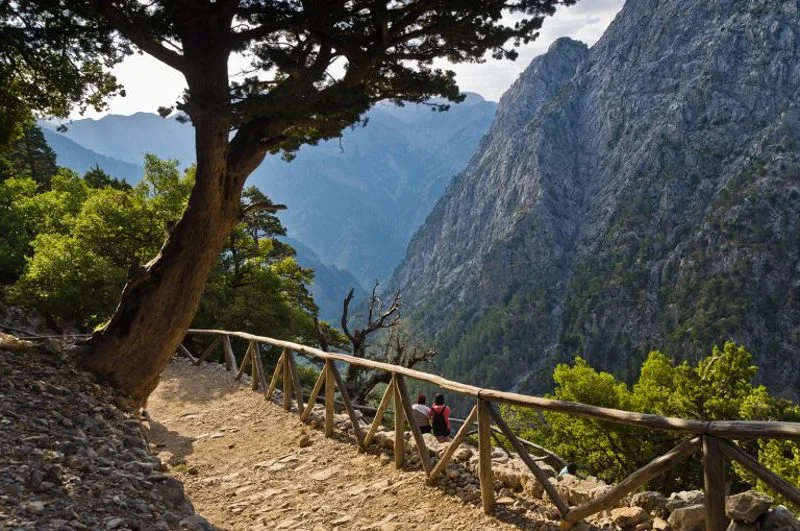
The standard hike begins at Xyloskalo, the wooden staircase entrance at the top of the gorge, which sits at roughly 1,200 metres altitude above the village of Omalos on the Omalos plateau. The descent from Xyloskalo is steep at the start and sets the tone for the first part of the walk.
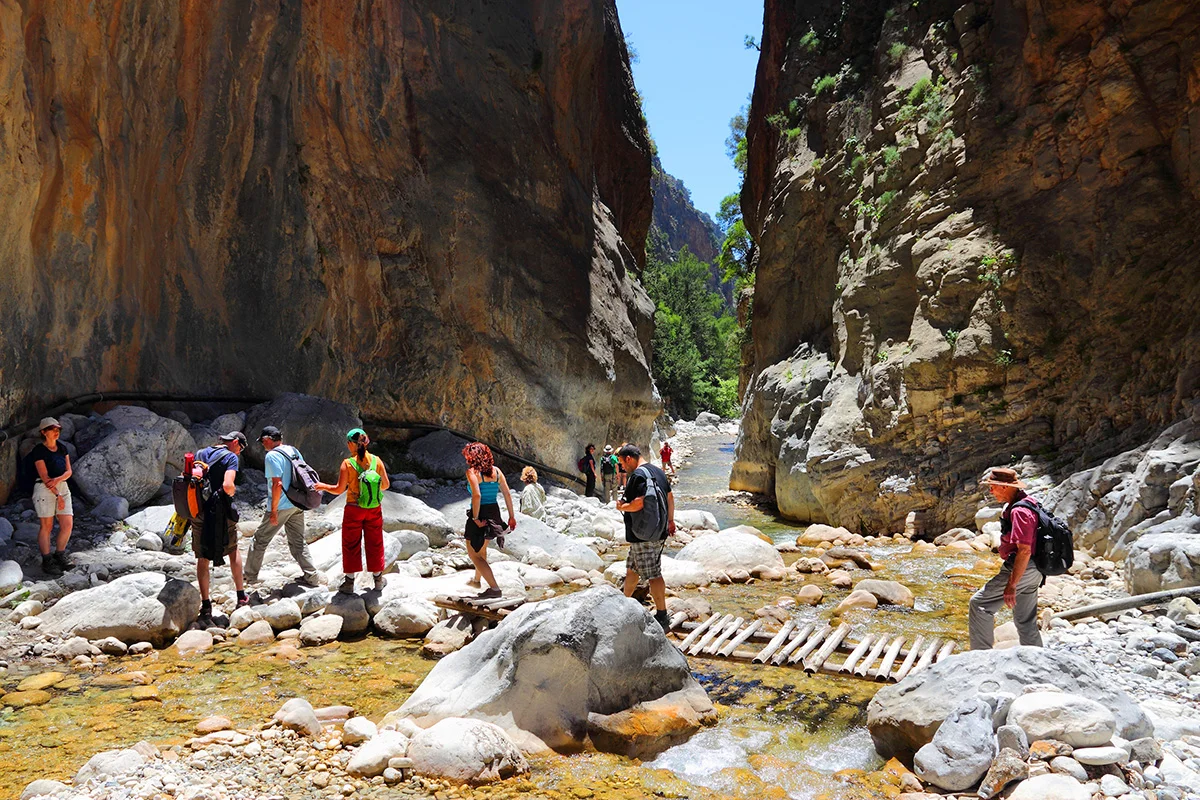
From the entrance, the trail descends through pine forest and rocky terrain toward the gorge floor. The path is well-marked and maintained, with wooden bridges crossing the stream bed in several places. In spring, the stream carries significant water and the crossings are part of the experience. By late summer, much of the stream bed is dry.
The Iron Gates section, roughly 11 km into the walk, is the narrowest and most photographed part of the gorge. The walls here are close enough to touch on both sides and rise to well over 300 metres. It is a disorienting and genuinely impressive stretch that most hikers remember clearly.
After the Iron Gates, the gorge opens and the path becomes more straightforward as it leads toward the old village of Samaria and then continues to the exit gates at the southern end of the park. From the exit gates, there is still a short walk of around 2 km to the waterfront at Agia Roumeli, so the total distance with that final stretch is closer to 18 km depending on the source.
Most hikers complete the route in 4 to 7 hours, with considerable variation depending on pace, fitness, and the amount of time spent at rest points. Fit walkers who move at a steady pace often finish in under 5 hours. Those who take their time, stop at the village, and walk slowly on the descent are more likely to need 6 or 7 hours.
Difficulty and Timing
Samaria Gorge is not classified as a technical mountain route. You do not need climbing experience or specialist equipment. However, it is a demanding hike because of its length, the uneven rocky terrain underfoot, and the cumulative effect of a long downhill walk on the knees and legs. A reasonable level of fitness is the honest requirement.
The descent is harder on the body than people expect. Going downhill for several hours is tiring in ways that flat walking is not, and the loose rock sections in the lower gorge require attention underfoot. Proper hiking shoes or trail shoes with grip are important. Sandals and flat-soled shoes are not suitable and are one of the most common causes of minor injuries on the trail.
The early opening hours are not arbitrary. They are there to ensure that hikers start with enough time to complete the walk before the late-afternoon exit window closes. Arriving at the entrance gate early, ideally by 7 or 8 in the morning, gives you the best conditions: lower temperatures, fewer other hikers on the path, and comfortable time to reach Agia Roumeli without rushing.
Starting late creates problems on two fronts. The summer heat in the gorge can be significant from mid-morning onward, and arriving at Agia Roumeli too late can mean missing the last ferry to Hora Sfakion. Both are avoidable with early planning.
Can You Go Without a Guide
Yes. The standard route is designed for independent hikers, and no guide is required. The trail is clearly marked, the entrance and exit gates are staffed during opening hours, and there is rescue infrastructure in place throughout the season.
What independent hiking does require is preparation. Water is essential, and you need more than you think. At least 2 litres per person is the standard recommendation, with more in July and August. There are water sources at some points along the trail, but they are not guaranteed throughout the season.
Sun protection matters more than most hikers anticipate, because parts of the gorge are exposed and the altitude does not reduce the intensity of the sun in the way people sometimes assume.
The main thing you must organize for yourself is the exit from Agia Roumeli. There is no road out. The options are the ferry to Hora Sfakion or Sougia, or an overnight stay in the village if you arrive too late for the last boat. Check ferry schedules before you start walking, not after. That is not a detail to leave to chance at the end of a long day.
Can You Swim in the Gorge
The gorge itself is not a swimming destination. The stream that runs through it in spring is too fast and too cold for recreational swimming, and in summer it is reduced to a shallow trickle in most sections. The water you will see inside the gorge is for looking at, not swimming in.
The swimming comes at the end. Agia Roumeli has a beach directly in front of the village, with clear water that faces south toward the open Libyan Sea. After a full day on the trail, most hikers consider that swim one of the better moments of the trip. The combination of physical effort and the contrast of arriving at the sea is something that a standard beach day cannot replicate.
There is also a second beach a short walk west of the main village waterfront, which tends to be quieter. Both options are easily found on foot once you arrive.
Route, Access, and Return
The trail entrance is at Xyloskalo on the Omalos plateau, accessible by road from Chania. The drive from Chania town takes roughly 45 minutes. There is no direct road access to the gorge from the south coast.
For travelers without a car, KTEL buses run from Chania to Omalos each morning during the hiking season, with departures timed for early entry. Organized day trips from Chania, Rethymno, and Heraklion are also widely available and include bus transport to the entrance and ferry and bus return from Hora Sfakion.
The return journey after the hike runs in reverse geographically. From Agia Roumeli, ferries depart for Hora Sfakion throughout the afternoon and early evening during the season. From Hora Sfakion, buses or taxis connect to Chania. If you drove to Omalos and left your car there, the taxi or bus from Hora Sfakion back to Chania followed by a return to Omalos is the standard solution. Several organized tours handle this logistics loop as part of the package.
Confirm the last ferry departure from Agia Roumeli before you begin the hike. Times vary by season and by day, and missing the last boat turns a completed hike into an overnight situation.
Weather and Best Time to Visit
The gorge is seasonal and can close temporarily or change its hours due to extreme weather or safety conditions. Flash flooding is the main risk in spring, and extreme heat is the main risk in July and August. The park authorities have the authority to close the trail on short notice, and that decision is not appealed.
The officially stated season runs from 1 May to 31 October, but the actual opening date in May can shift slightly depending on winter snowmelt and trail conditions. If you are planning a trip specifically around the gorge in early May, it is worth checking the current status before you travel.
May and June are generally the best months for hiking. The trail is fully open, temperatures are manageable, the stream still has water, and the wildflowers in the gorge and on the Omalos plateau are at their best. The crowds are lower than in high summer.
July and August are the busiest months. Heat inside the gorge can be significant, particularly between late morning and mid-afternoon, and the number of hikers on the trail is at its highest. Early starts help with both issues, but the experience is less comfortable than in shoulder season.
September is a strong choice. The summer heat is easing, the trail is fully operational, and the crowds have thinned considerably. The light in the gorge in September has a quality that photographs well and that many hikers prefer to the harsh midday glare of peak summer.
October is possible, with the caveat that conditions can become unpredictable toward the end of the month and some ferry services on the south coast begin to reduce their frequency.
Food, Stops, and Nearby Places
Inside the gorge, there are rest stations at intervals along the route where water is available and basic facilities are provided. These are functional stops rather than food or drink options. Bring your own snacks, energy food, and water from the start.
Agia Roumeli is where the post-hike eating happens. The village is small, with a line of tavernas along the waterfront that cater almost entirely to hikers finishing the trail. The food is straightforward, the portions are large, and the cold drinks are the main draw after several hours on foot. The quality is consistent rather than remarkable, but the setting makes everything taste better.
If you stay overnight in Agia Roumeli to catch an early morning boat, a few small guesthouses and rooms are available. The village is quiet in the evenings and has no nightlife, which suits most people after a full day's walking.
The south coast around Agia Roumeli is worth exploring if your schedule extends beyond a single day. Loutro, accessible by ferry and with no road connection, is one of the more atmospheric villages on the Cretan south coast. Lykos, Marmara, and Finikas are smaller stops along the same ferry route that offer quiet beaches and a very different character from the north coast resorts.
For hikers interested in other gorge routes in western Crete, the Imbros Gorge near Hora Sfakion is a shorter and less demanding alternative that runs along a similar south-facing landscape.
Practical Tips
Start early. The gorge opens at dawn and the benefits of an early start are real: lower temperatures, a quieter trail in the first hours, and enough time to finish comfortably without watching the clock.
Wear proper footwear. Trail shoes or hiking shoes with grip are required. The rocky and uneven terrain in the lower gorge is the part where footwear matters most, and it is also the part where most people are already tired.
Bring more water than you think you need. 2 litres minimum per person, more in summer. The walk is longer than most people's daily movement, and dehydration is the most common reason people struggle on the trail.
Check the ferry schedule before you enter the gorge. Know the last departure time from Agia Roumeli and plan your pace accordingly. If you are on an organized tour, this is handled for you. If you are independent, it is one of the two or three details that genuinely matter on the day.
Protect against the sun. A hat, sunscreen, and light long sleeves for the exposed sections of the trail are standard kit, not optional extras. The altitude and the mountain context can make the sun feel less intense than it actually is.
Nearby Attractions
The gorge sits in a part of Crete that rewards spending more than a single day in the area. Chania town, roughly 45 minutes from the Omalos plateau, is one of the most architecturally interesting cities in Greece. The Venetian harbour, the covered market, and the old quarter can fill a full day without effort.
The Omalos plateau itself, where the gorge entrance is located, is a high-altitude agricultural plain that feels completely different from coastal Crete. The drive up to Omalos through the mountain villages is part of the experience, particularly in spring when the plateau is still green.
Along the south coast, Hora Sfakion is the practical transit hub for ferry arrivals from Agia Roumeli and is worth a meal or a coffee while waiting for onward transport. It is a small, functional town with a strong maritime identity and a seafront that faces south toward open water.
For hikers who want to compare routes, the Imbros Gorge begins near the village of Imbros and ends close to Hora Sfakion. At around 8 km it is roughly half the length of Samaria, less regulated, and considerably less crowded. It is a good option for travelers who want a gorge experience without committing to a full-day walk or who want to do a second route after Samaria.
Samaria is best understood as the centerpiece of a western Crete itinerary rather than an isolated day trip. The area around it, from the White Mountains to the south coast ferry routes, offers a version of Crete that most visitors who stay on the north coast never see.
Let Crete come to you
Sign up to get authentic stories, travel tips, and new experiences
By entering my email, I agree to receive marketing notifications from travel & do.