 Back to blog
Knossos Guided Tour: What You Get, What It Costs and How to Plan the Day
On this page
- Quick Summary
- Introduction
- What a Knossos Guided Tour Actually Includes
- A licensed guide, not a ticket
- How long the tour runs
- What you pay on top
- Why a Guide Changes the Site
- History and Identity
- Minos Kalokairinos, 1878
- Arthur Evans, 1900 to 1931
- The argument about the concrete
- UNESCO, 2025
- The Labyrinth and the Minotaur
- The Palace and the Museum
- Tickets, Prices and What Is Not Included
- Weather and the Best Time to Visit
- Getting There from Heraklion
- Guided, Audio Guide or Ticket Only: A Comparison
- Ticket only
- Audio guide
- Licensed guide
- How to Choose Your Knossos Tour
- Common Mistakes to Avoid
- Assuming the ticket is included
- Arriving at midday in July
- Skipping the museum
- Trying to visit the museum on a Wednesday morning
- Believing the "closed on Tuesdays" line
- Bringing a drone
- Where to Stay
- Nearby Attractions
- Final Thoughts
Quick Summary
A guided tour of Knossos means a state licensed guide walking you through the palace for roughly ninety minutes. It does not normally mean a ticket. Entry to Knossos is €20 for adults, paid separately to the Greek state, and entry to the Heraklion Archaeological Museum is another €20 the two are ticketed independently, so a day that covers both costs about €40 a head in admission before any guide. Knossos opens at 08.00 and stays open every day of the week; the museum opens at 08.00 too, except on Wednesdays, when it does not open until 13.00 in summer. In July 2026 the site was closed over the hottest hours on two consecutive days after visitors collapsed, so an early start is now a safety decision as much as a crowd one.
Introduction
Knossos passed a million visitors in 2024, 1,026,113 of them and in high summer more than five thousand people a day come through the gate, a surge that Greek reporting ties directly to the growth of cruise calls at Heraklion. What almost none of them are given is an explanation. The site carries very little interpretive signage, and the parts that are easiest to photograph are the parts Arthur Evans rebuilt in reinforced concrete a century ago. Without someone to tell you which is which, a great deal of Knossos reads as low walls and gypsum slabs.
That is the honest case for a guide, and it is a stronger case here than at most ancient sites. This guide covers what a guided tour of Knossos includes and what it leaves out, the real cost once the state ticket is added, how the palace relates to the museum in town, and the practical details hours, heat, buses, crowds that decide whether the day works. It is written for people who have already decided to go and now want to book the right thing.
What a Knossos Guided Tour Actually Includes
A licensed guide, not a ticket
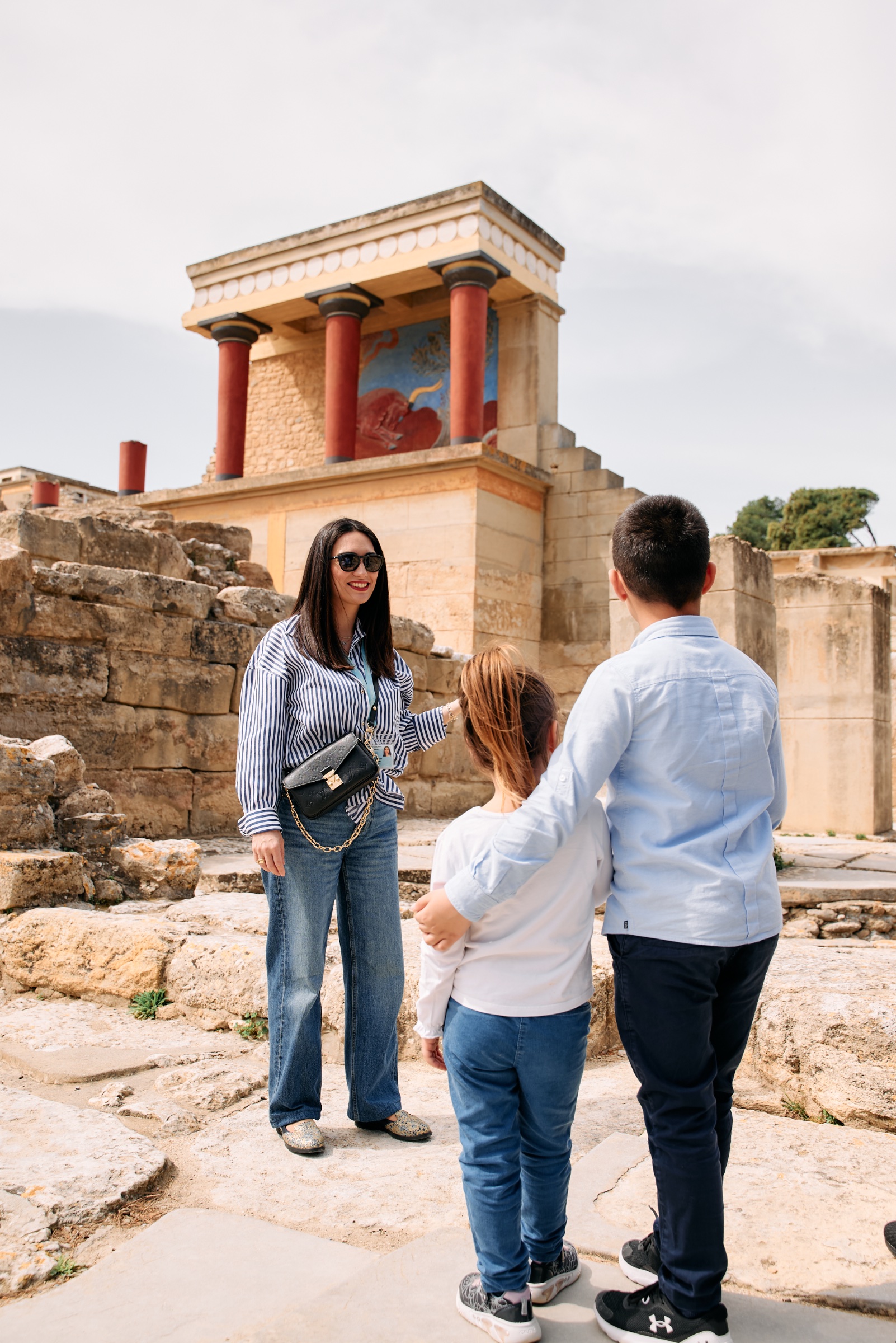
Only state-certified guides may lead a tour inside a Greek archaeological site, and they are required to carry an official badge. Almost every guided Knossos product sold online is therefore a professional service rather than an admission package: you are buying the guide's time and licence, and the entrance fee stays your responsibility. Read the inclusions line before you book. A tour that says "guided tour by a licensed tourist guide" and then, further down, "the entrance tickets are not included in the price of the tour" is being straightforward with you, and it is the most common shape in the market.
How long the tour runs
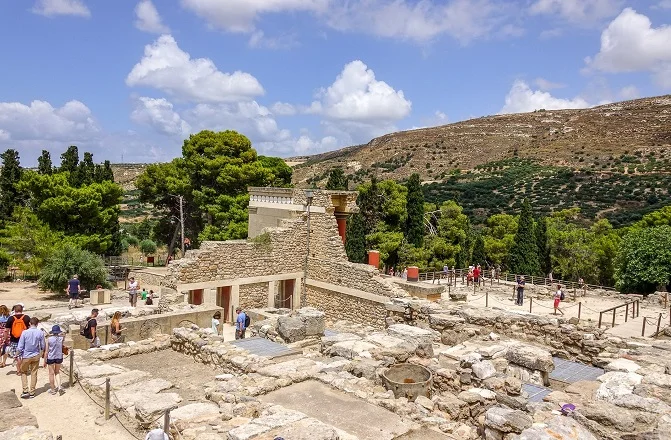
The standard guided walk at Knossos is about ninety minutes, and that is a sensible length. It is long enough to cover the west wing and the throne room, the central court, the storage magazines with their great jars, the north entrance and the residential quarter on the east side, with time to stop in what shade there is. Allow around two hours on site in total if you want to wander afterwards and read what panels there are. Anything sold as a thirty-minute highlights tour is not a tour of Knossos; anything over three hours is usually a day trip with Knossos inside it.
What you pay on top
Three things routinely sit outside the headline price: the entrance ticket, transport to the site, and anything you eat. Guided tours are also commonly priced per person with a two-person minimum, which matters for solo travellers a "from €80" tour can have a real floor of €160. Transfers, where offered at all, are usually a separate on-the-day charge rather than something bundled into the online price. And be careful with the phrase "skip the line": a guide-only tour where you buy your own ticket at the gate gives you no priority entry at all, whatever the marketing around it suggests. None of this is a trick, but it is the reason an €80 tour and a €180 tour can turn out to cost the same once both are complete.
Why a Guide Changes the Site
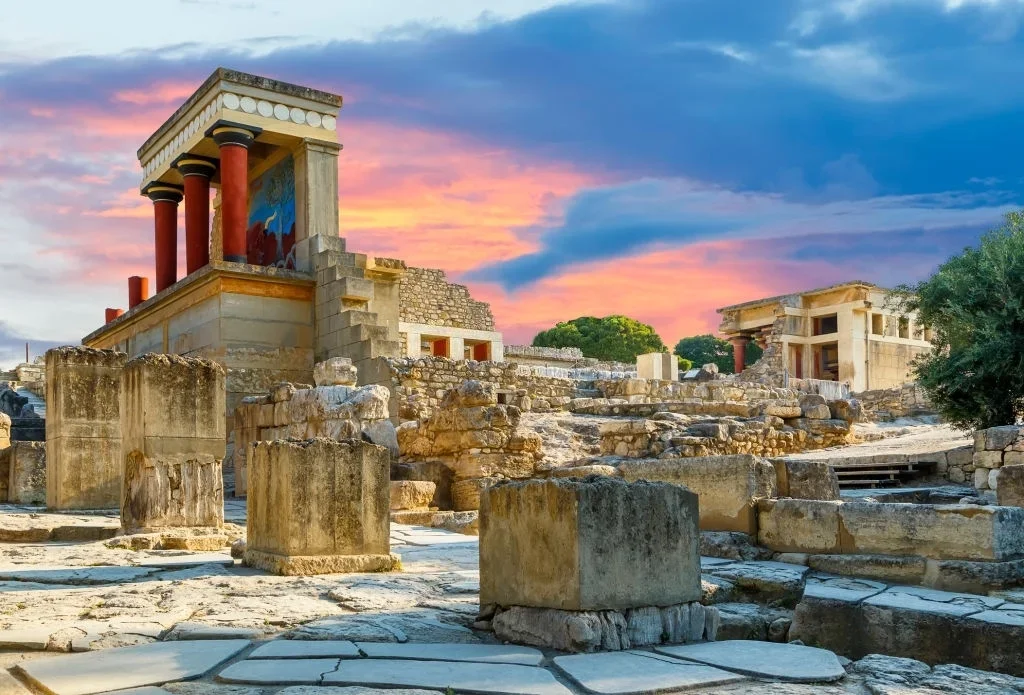
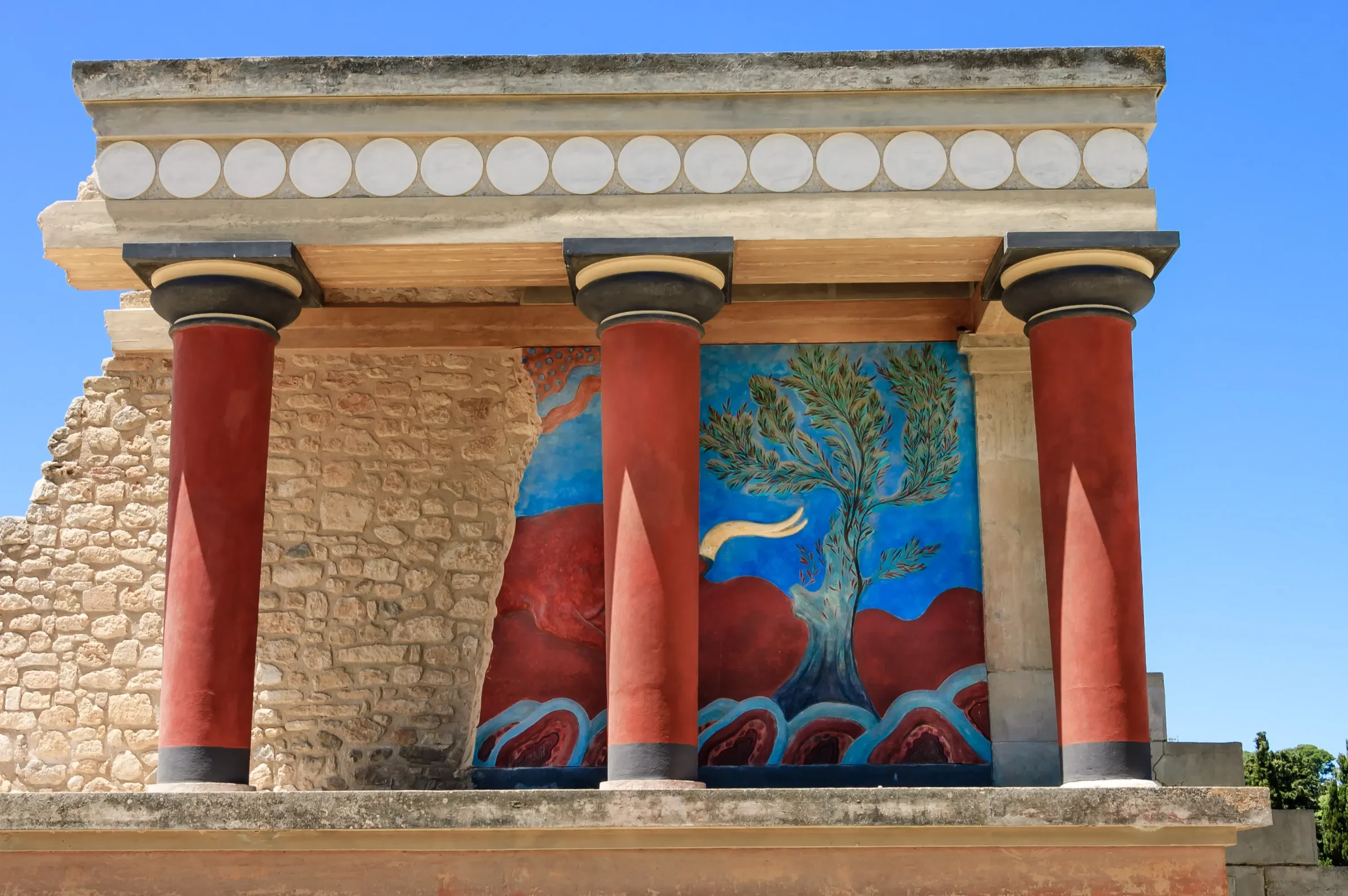
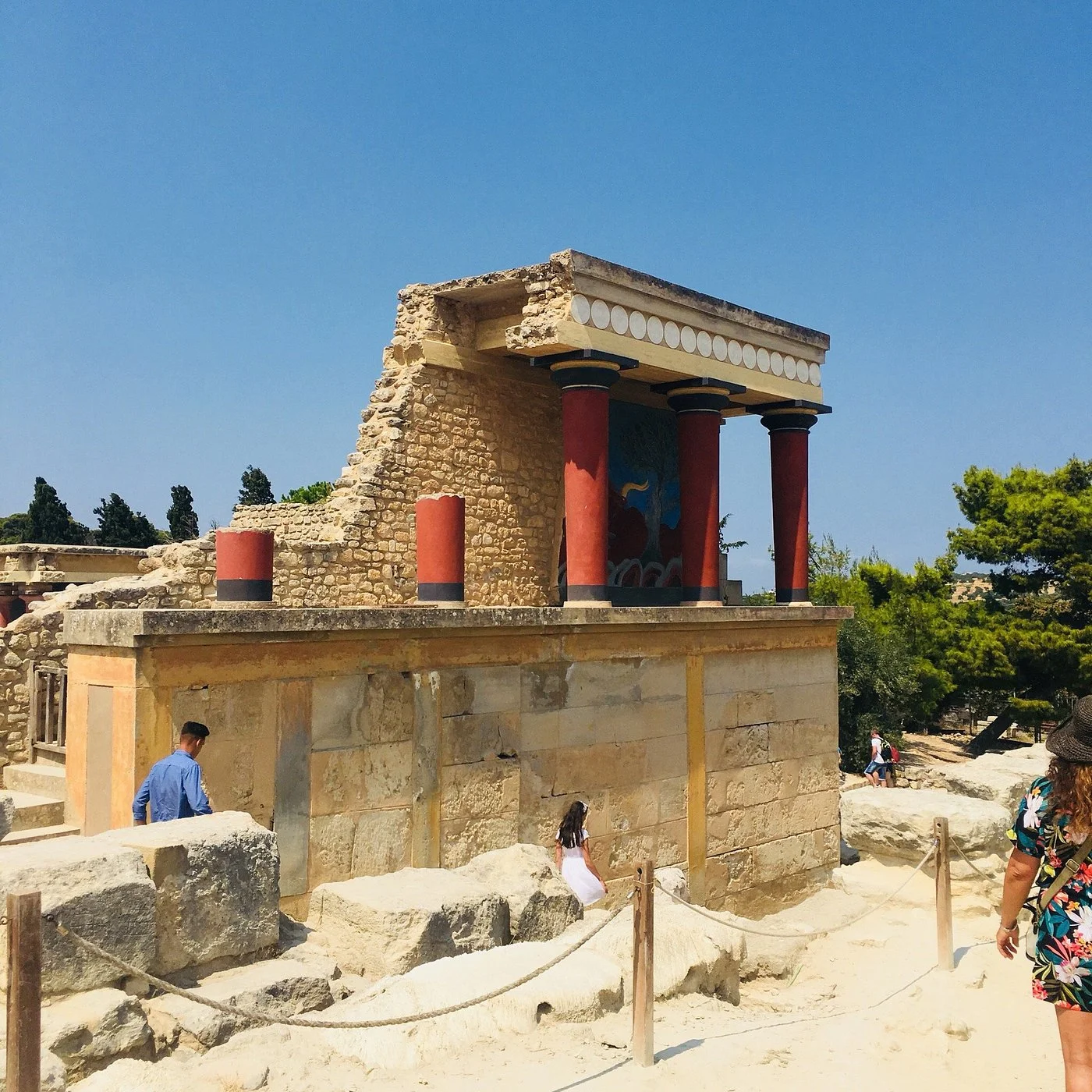
At Knossos the guide is not decoration, because the central problem of the site is that you cannot see what is old. Between 1900 and 1931 Arthur Evans and his architects raised walls, columns and whole upper storeys in steel and reinforced concrete, and had the frescoes repainted from fragments. The result is the most legible Bronze Age site in Europe and, simultaneously, the most argued-about. A good guide spends much of the walk telling you which surface is Minoan, which is Evans, and how confident anyone can be about the difference and supplies the scale in time that the stones do not. The hill was lived on continuously from the Neolithic, around 7000 BC; the Greek Ministry of Culture dates the palace to roughly 2000–1350 BC, with a first palace around 1900 BC, a second built over its ruins, and Mycenaean rule after the island-wide destructions of about 1450 BC. Standing in the central court, none of that is visible.
History and Identity
Minos Kalokairinos, 1878
Knossos was not found by Arthur Evans. It was first dug in 1878 by Minos Kalokairinos, a Cretan merchant and antiquarian from Heraklion, more than twenty years before Evans arrived. His short campaign on the Kephala hill opened storerooms in the west wing, a corner of what was later identified as the throne room complex, and the great storage jars standing in them. The Ottoman authorities who then controlled Crete shut the dig down after about three weeks. He was an amateur rather than a trained archaeologist, and that, along with Evans's later fame, is most of the reason his name is missing from the postcards.
Arthur Evans, 1900 to 1931
Evans broke ground in 1900 and worked at Knossos until 1931. He bought the land, he funded much of the work himself, and he named the civilisation "Minoan" after the legendary King Minos. The intensive excavation was concentrated in the first seasons; much of the three decades that followed went into restoration, publication and study. He was Keeper of the Ashmolean Museum in Oxford for most of that period, which is why Minoan fresco fragments from Knossos are in Oxford to this day.
The argument about the concrete
Evans called his rebuilding "reconstitution", and archaeologists have argued about it ever since. Parts of it go well beyond the surviving evidence the north entrance bastion with its charging bull is the standard example. The frescoes were reconstructed from small fragments by his artists. And concrete is effectively irreversible, which freezes the site inside an early twentieth-century interpretation that a visitor cannot easily separate from the Bronze Age fabric. The counter-argument, which the Greek Ministry of Culture makes, is that most of the interventions were imposed by the need to keep what had been uncovered from collapsing. Both positions are serious. Anyone who tells you Evans simply invented the Minoans is overstating the mainstream view.
UNESCO, 2025
This is the detail most guidebooks and most websites have not caught up with. For decades it was wrong to call Knossos a World Heritage Site — it sat on Greece's tentative list. That changed in 2025, when Knossos was inscribed as one of six component parts of the serial property "Minoan Palatial Centres", alongside Phaistos, Malia, Zakros, Zominthos and Kydonia, under cultural criteria (ii), (iii), (iv) and (vi). The inscription decision is unusually candid about the reconstruction problem: it records that the property faces challenges from the extensive rebuilding carried out in the early twentieth century, and formally asks Greece to make the line between authentic remains and later reconstruction clearer to visitors. If a page you are reading still calls Knossos "tentative list only", it was written before July 2025.
The Labyrinth and the Minotaur
There is no maze at Knossos and there never was. No labyrinth has been excavated, and none is expected. What is real is the relationship between the legend and the building: the palace's sprawling, many-roomed plan, stacked over several levels around a central court, is widely accepted as the kind of structure that produced the story, and UNESCO's own inscription text describes architecture that passed into ancient Greek memory as the Labyrinth. That is a warm, defensible way to tell it.
The tidier claim — that "labyrinth" derives from labrys, the Minoan double axe carved around the site — is a nineteenth-century suggestion that scholars still dispute, and the decipherment of Linear B weakened it rather than confirming it. Double axes turn up all over Crete, not only here. Treat it as an idea worth hearing on the walk, not as a fact to repeat afterwards. A guide who presents it as settled is oversimplifying.
The Palace and the Museum
The single most useful thing to understand before booking is that Knossos has been split in two. The site has the architecture; the Heraklion Archaeological Museum, five kilometres away in town, has the objects. The painted panels you see on the walls at Knossos are copies, installed during Evans's reconstruction. The originals of the famous frescoes are in the museum, and so is nearly everything else that came out of the ground.
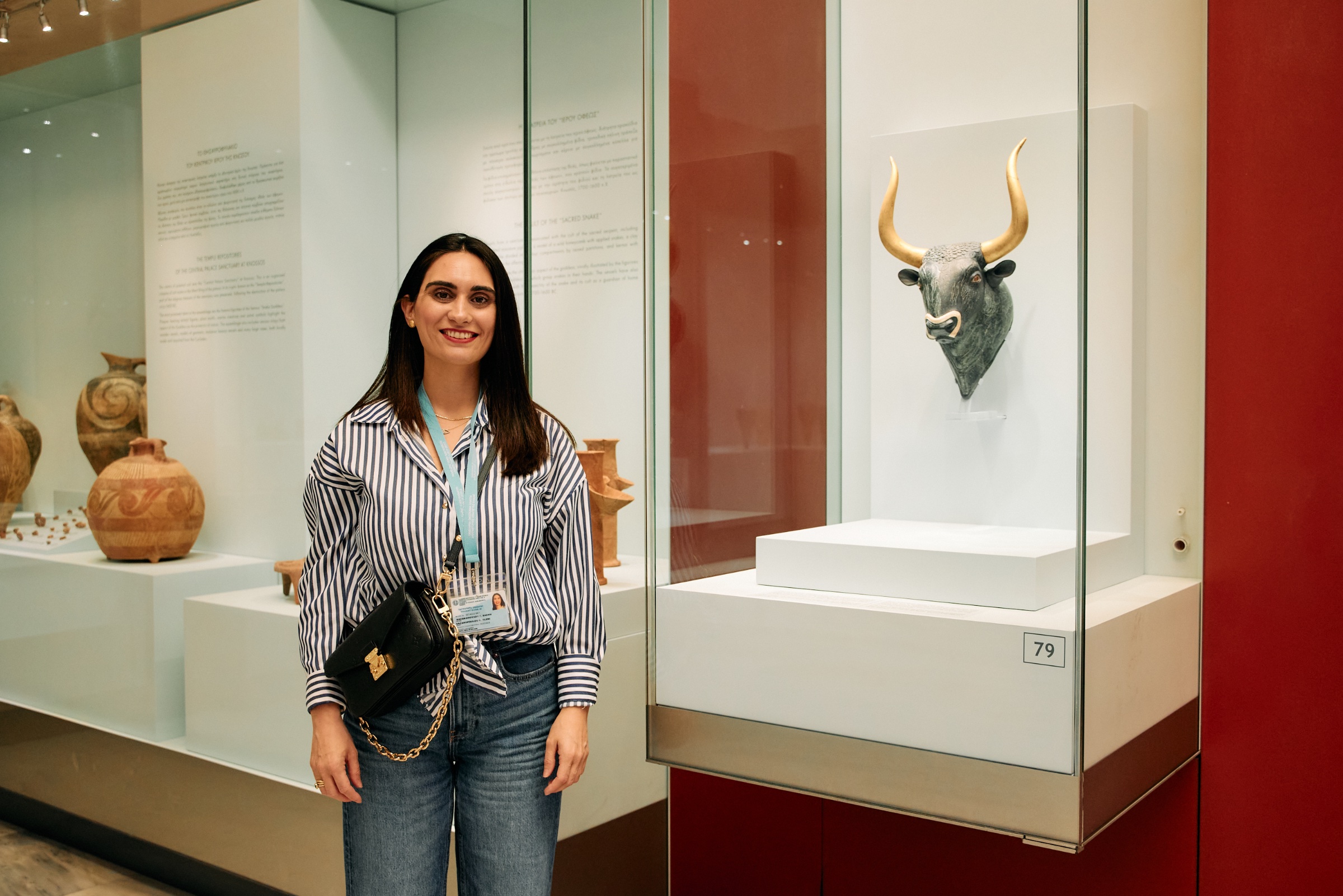
The museum's collection fills 27 rooms arranged in chronological and thematic units, covering roughly seven millennia from the Neolithic to Roman Crete, and it reopened in 2014 after a major EU co-funded restoration of the building and a complete redesign of the display. Its best-known pieces include the Bull-Leaping (or Toreador) fresco, the faience Snake Goddess figurines, the Prince of the Lilies, the stone bull's-head rhyton from the Little Palace at Knossos, the gold signet ring from Isopata, the Hagia Triada sarcophagus and the Phaistos Disc.
One accuracy note on that last object, because it is the single most commonly mangled fact in Crete travel writing. The Phaistos Disc is not written in Linear A. It carries 241 stamped signs arranged in a spiral, it was found by the Italian archaeologist Luigi Pernier at Phaistos on 3 July 1908, and it is undeciphered — experts have not settled its contents or even its relationship to Crete's three other early scripts. Anyone who tells you it says something specific is guessing.
ADD CARDS HERE
Tickets, Prices and What Is Not Included
Full admission to Knossos is €20, and full admission to the Heraklion Archaeological Museum is also €20, both checked in August 2026. Any page still quoting €15 for Knossos predates the April 2025 repricing of Greek state sites. Concession rates exist at both venues, but the eligibility windows published by the Ministry and by the museum do not agree with each other and neither window covers June to September, so a summer visitor should budget the full price and ask at the desk rather than plan around a discount.
Free entry is broader than most visitors realise: admission is free year-round for under-25s who are citizens of an EU member state and for under-18s from outside the EU, on presentation of ID or a passport, and free for visitors with a disability certificate plus one companion. There are also fixed free days — 6 March, 18 April, 18 May, the last weekend of September, 28 October, and the first and third Sunday of each month from 1 November to 31 March. Note that it is the first and third Sunday, not only the first; the older version of that rule is still widely copied. None of those days falls between June and September.
The combined ticket deserves a warning. A single Knossos-plus-museum ticket, valid three days, is quoted all over the internet at both €20 and €30. The official state ticket store now lists exactly one product for each venue at €20 apiece and no combined product at all, and the museum's own current pricing table shows €20 with no combined line; only a stale museum FAQ page still mentions one, without a price. Budget for two separate €20 tickets, roughly €40 for both sites, and treat anything cheaper as a bonus rather than a plan.
Tickets are sold through the official state platform, and an online ticket is valid for a single entry on a chosen date and time slot. That matters if you are also booking a guide: many guided tours expect you to buy at the gate on arrival, so if you pre-book online, make the slot match the tour's start time rather than assuming the two will line up. Buying ahead is sensible in high summer but it is not compulsory — the museum still sells at its own desk by card. Note also that state tickets are non-refundable, so cancelling a guided tour does not get the admission back.
Weather and the Best Time to Visit
Knossos is almost entirely open ground. There are no canopies over most of the excavated areas, the stone reflects heat, and the walk takes around two hours. In July and August this is a genuine problem rather than a discomfort. On Tuesday 21 July 2026 two visitors collapsed at the site as the on-site temperature reached 43°C, and the palace was closed from 13.00 until 17.00; it closed again the following day from 12.00. The same midday-shutdown measure has been used repeatedly at Greek sites in earlier summers. These closures are declared day by day at short notice, not published in advance, so in a heatwave the only safe plan is to be there at opening.
Spring and autumn are simply better: April, May, September and October give you a walkable site, longer light on the ruins and far fewer coaches. The site is open every day of the week year-round, closing only on 1 January, 25 March, Easter Sunday, 1 May, 25 December and 26 December, and opening late, from 12.00, on Good Friday.
Hours shift through the season rather than switching once. Knossos opens at 08.00 and closes at 20.00 from 1 April, stepping back to 19.30 from 1 September, 19.00 from mid-September, 18.30 from 1 October and 18.00 from mid-October; from 1 November it runs 08.30 to 17.00. Last admission is before the stated closing time at both venues, so do not arrive in the final half hour.
Getting There from Heraklion
Knossos sits about five kilometres south of Heraklion city centre, which makes it one of the easiest major archaeological sites in Greece to reach without a car. City bus line 2, run by Astiko KTEL Irakleiou, goes from the port bus station to Knossos and back, calling at Bus Station A and then at Eleftherias Square — the stop outside the Archaeological Museum — before climbing Knossos Avenue to the site. The ride takes roughly twenty minutes. Buy the ticket before boarding, since paying the driver costs more, and check the current timetable on astiko-irakleiou.gr, because the schedule changes seasonally.
That bus route is the practical argument for doing both sites in one day: the museum is not a detour from the Knossos bus, it is a stop on it. You can step off at Eleftherias Square on the way out or pick the bus up outside the museum afterwards, with no walk in between. From the cruise passenger terminal it is about a fifteen-minute walk into that part of town.
A taxi from the centre takes about ten minutes; agree the fare before you set off or make sure the meter is running, because Greek tariffs vary by time and pickup point. If you drive, there is parking by the site, but the lots vary — some free, some private and charging — so read the signage rather than following whoever waves you in.
Guided, Audio Guide or Ticket Only: A Comparison
Ticket only
The cheapest way in, at €20, and the weakest experience unless you have read something beforehand. The signage will not carry you. This works for repeat visitors, for archaeology readers who already know the plan of the palace, and for anyone on a tight schedule who mainly wants to stand in the central court. It does not work as a first encounter for someone who wants the site explained.
Audio guide
A reasonable middle. Be clear about what you are buying, though: there is no state-run audio guide at Knossos. Every audio option is a commercial third-party product — a smartphone app bought online, or a tablet handed over at a private operator's meeting point outside the gate. Nothing is issued at a desk by the site itself, so "the official audio guide" does not exist and any page promising one is wrong. An app suits independent travellers who want to move at their own pace and stop where they like.
Licensed guide
The strongest version, and the one this page recommends for a first visit. A licensed guide answers questions, adjusts the depth to your group, and — crucially at Knossos — separates the reconstruction from the ruin as you walk. You can also hire a guide at the gate: licensed guides wait at the entrance and take groups on the spot once enough people have gathered. That is a legitimate route, though it is not guaranteed on any given day, prices are negotiated rather than published, and you have no control over who you get or which language they work in. Booking ahead buys certainty on all three.
How to Choose Your Knossos Tour
Start with the group size, because it changes the experience more than the price does. A small-group walk of eight to ten people lets you hear the guide and ask questions; a coach group of forty does not. If you are two people, compare the per-person price honestly against private tours quoted per group — a private tour priced for up to two often lands close to two small-group seats and gives you the guide's full attention.
Then decide whether you want the museum in the same booking. Palace-then-museum is the sequence most people prefer, because the architecture gives the objects a home; museum-then-palace suits anyone who wants to know what the frescoes actually looked like before seeing the copies in place. Either order works. What does not work is booking a guided palace tour that ends at 13.00 on a Wednesday and assuming you can walk into the museum afterwards, because in summer the museum does not open until 13.00 on Wednesdays and you will be queueing rather than arriving.
Finally, check language and start time. Morning slots around 09.00 are the best combination of cool air and thin crowds. And confirm the cancellation window: twenty-four hours is the market standard, and it is worth having in a month when the site can close for the afternoon at a few hours' notice.
Common Mistakes to Avoid
Assuming the ticket is included
The most expensive mistake, because it is a €20-per-head surprise at the gate for a family. Read the inclusions.
Arriving at midday in July
The site fills through the middle of the day as coaches and shore excursions arrive, and in a heatwave it may simply be shut. Open early, or come in the last hours before closing.
Skipping the museum
Seeing only Knossos means seeing only copies of the frescoes. The originals are twenty minutes away on the same bus. A palace without its objects is half the story.
Trying to visit the museum on a Wednesday morning
In summer it opens at 13.00 on Wednesdays. This one catches people every week.
Believing the "closed on Tuesdays" line
The Heraklion Archaeological Museum no longer has a weekly closing day, and neither does Knossos. Guidebooks and even some official boilerplate still repeat the old rule.
Bringing a drone
Aerial photography over Greek archaeological sites requires written Ministry of Culture permission, which visitors do not get. Ordinary hand-held photography without flash is free.
Where to Stay
Heraklion city is the obvious base for a Knossos day, and the practical reason is the number 2 bus: from anywhere inside the Venetian walls you are twenty minutes from the palace and a few minutes' walk from the museum, without a hire car or a parking decision. The area around Eleftherias Square and the old town puts you between the two sites with the restaurants in between. Staying out of town works too and simply changes the shape of the day — the Ammoudara and Agia Pelagia side of the coast adds a beach to the afternoon, while the wine villages inland at Archanes and Peza sit twenty minutes further south on the same side of the city. Families and groups often prefer a villa with a kitchen and a pool, because this day works best when it starts early and ends slowly.
Nearby Attractions
The Heraklion Archaeological Museum is the essential companion and is covered above. Beyond it, the Koules fortress guards the old harbour, and the old town runs up from the port along 25 Avgoustou towards the Morosini fountain, the market and the cathedral — a short, flat walk that suits the hours after a hot morning at the palace. The wine country south of the city is the most natural pairing with Knossos, both geographically and thematically, with the estates around Archanes and Peza within twenty minutes of the site. Matala, with its carved caves above the Libyan Sea, belongs to a different day, and Dia island, seven nautical miles offshore, is the other easy escape from the capital.
Final Thoughts
Knossos rewards preparation more than almost any site in Greece, because so much of what makes it extraordinary is invisible without explanation — the three thousand years of continuous occupation, the two palaces stacked on one hill, and the century-old concrete that made the place legible and controversial at the same time. A licensed guide is the most reliable way to get that, and the 2025 UNESCO inscription, with its explicit call to distinguish authentic remains from reconstruction, is essentially an official endorsement of the same point.
Book the guide, budget the €20 ticket separately, start early enough to beat both the coaches and the heat, and give the Heraklion Archaeological Museum the second half of the day. That is the version of this trip that people remember.
Frequently asked questions
Is a guided tour of Knossos worth it?
For a first visit, yes. Knossos carries very little explanatory signage, and much of what you see is Evans's early twentieth-century reconstruction rather than Bronze Age fabric. Without a guide, a large part of the site reads as low walls. A licensed guide separates the rebuilt from the original and gives the plan of the palace a shape you can follow.
How much does a Knossos guided tour cost?
Guided walks are generally sold per person for a tour of about ninety minutes, with the state entrance ticket excluded. Budget the tour price plus €20 per adult for admission. Many tours also carry a two-person minimum, so a solo traveller should check the floor price before booking.
Does the Knossos tour price include the entrance ticket?
Usually not. Most guided products in this market are guide-only services, because only state-licensed guides may lead tours inside Greek archaeological sites and the admission fee is collected separately by the state. Check the inclusions line; a tour that says entrance tickets are not included is telling you the truth about how the market works.
How long do you need at Knossos?
Allow around two hours on site. A guided walk is typically ninety minutes, and half an hour afterwards is enough to revisit the central court or the storage magazines at your own pace. Add twenty minutes each way from Heraklion, and a further two hours if you are adding the museum.
Should I visit Knossos or the museum first?
Either works, and the decision is about what you want the day to build towards. Palace first gives the objects a home when you meet them in town; museum first means you know what the frescoes originally looked like before you see the copies in place. The only hard constraint is the museum's Wednesday opening, which is 13.00 in summer.
Is Knossos a UNESCO World Heritage Site?
Yes, since 2025. It was inscribed as one of six component parts of the serial property "Minoan Palatial Centres", together with Phaistos, Malia, Zakros, Zominthos and Kydonia. Before 2025 it sat on Greece's tentative list, which is why a lot of older writing says otherwise.
Can I hire a guide at the entrance instead of booking?
Often, yes. Licensed guides wait at the entrance and form groups on the spot. It is a real option and sometimes a cheap one, but nothing is guaranteed on a given day, the price is negotiated rather than published, and you cannot choose the language or the guide. Booking ahead is the safer route in high season.
Is Knossos suitable for children?
From about six upwards it works well, mainly because the Minotaur story gives children a reason to keep walking. The ground is uneven and there is almost no shade, so go early, keep it to about an hour of concentration, and bring water and hats.
Related Articles
Continue exploring Crete
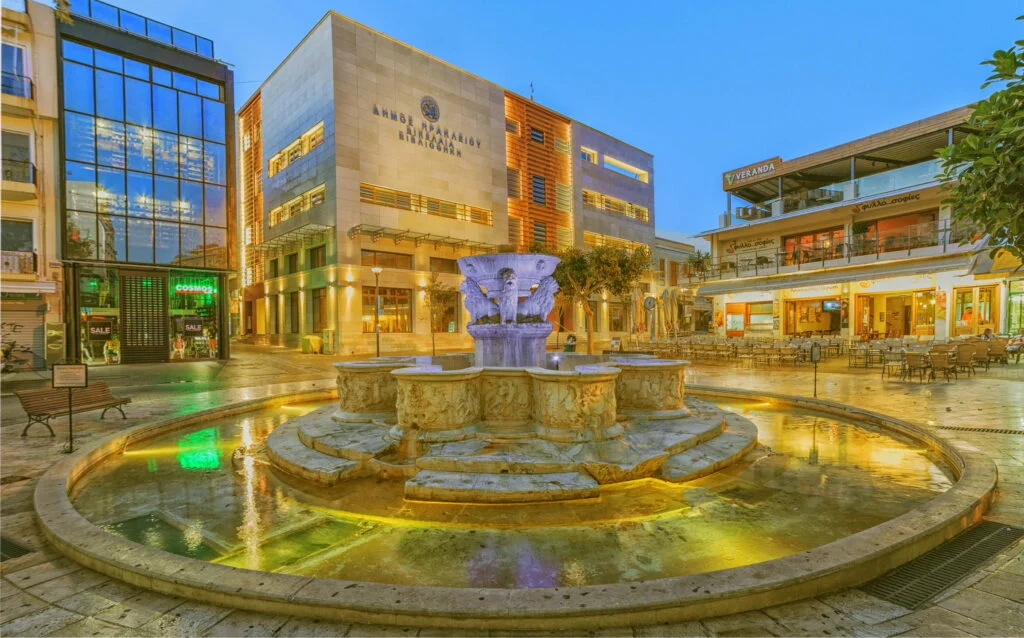
Morosini Fountain, Heraklion: The Venetian Monument at the Heart of the City
Morosini Fountain is one of Heraklion's best-known landmarks, and it sits right in the middle of the city's busiest historic square. Its Venetian design, lion heads, and central location make it an easy stop on any walk through the old town. This guide answers the most common visitor questions and explains why the fountain matters in the city's story.
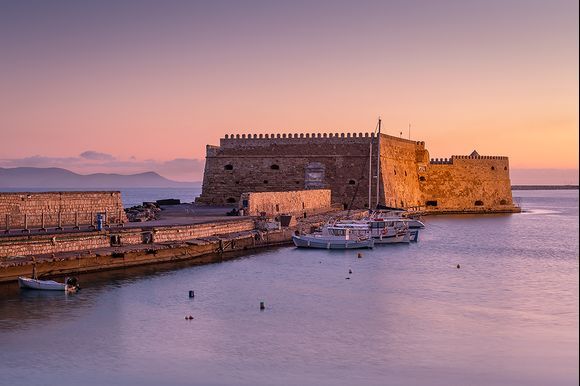
Koules Fortress: Is It Worth Visiting and How to Fit It Into a Heraklion Day
Koules Fortress stands at the entrance of Heraklion harbour, where it has dominated the waterfront for five centuries. If you are spending a day in Crete's capital, this is the landmark that sets the tone for the rest of the city. It connects directly to the Old Town, the harbour promenade, and some of the best eating and walking in central Heraklion. Start here and the rest of the day falls into place.
Knossos Palace in Crete: Worth It, Tickets, Labyrinth and What It’s Famous For
Knossos Palace is one of Crete's most talked-about archaeological sites, and for good reason. It combines Minoan history, royal quarters, ceremonial spaces, and one of Greece's best-known myths. This guide answers the questions people actually ask before they go, from tickets to the labyrinth story.
Let Crete come to you
Sign up to get authentic stories, travel tips, and new experiences
By entering my email, I agree to receive marketing notifications from travel & do.